
0512-6856 7071
info@ecellbio.com
方案一 小鼠外周血Th亚群鉴定方案
刺激剂的配制:
PMA(Cat#1652981)
贮存液:PMA溶于DMSO(二甲基亚砜),浓度为0.1mg/ml,-20℃分装保存。
工作液:贮存液1:4稀释于培养基(不含血清)或PBS(无菌,无NaN3)中,此时为25 μg/ml。
工作浓度:25 ng/ml(工作液稀释1000×)
Ionomycin
贮存液:Ionomycin溶于DMSO,浓度为1 mg/ml,-20℃分装保存。
工作液浓度:1 μg/ml(贮存液稀释1000×)
BFA
贮存液:BFA溶于DMSO,浓度为5 mg/ml,-20℃分装保存。
工作液浓度:10 μg/ml(贮存液稀释500×)
细胞刺激:
小鼠外周血(肝素抗凝)200 μl加入24孔板内,加入800 μl的完全培养基,再加入1 μl PMA(25 ug/ml)、1 μl Ionomycin(1 mg/ml),轻轻吹打混匀细胞。放入CO2培养箱培养刺激0.5 h后,每孔再加入2 μl Brefeldin A(5 mg/ml),轻轻吹打混匀细胞,放入CO2培养箱培养刺激3.5h。
流式检测:
1、收集细胞于流式管内,500 g/8 min离心,枪头吸去上清,弹散管底沉淀,加入相应的表面染色抗体(CD3/CD4),弹散混匀。室温避光孵育15 min后,500 g/8 min离心,枪头吸去上清;
2、弹散管底沉淀,加入1 ml的固定/破膜工作液,(1 ml Fixation/Permeabilization Concentrate加入3 ml Fixation/Permeabilization Diluent稀释),涡旋混匀,现配现用;
3、室温避光孵育30 min,600 g/10 min离心,在吸水纸上倒扣流式管弃去上清(此时细胞已在管底形成很牢固的沉淀不容易丢失),弹散管底沉淀。
4、加入1 ml Permeabilization Buffer(此为10×,须与蒸馏水1:10稀释成工作液)工作液离心洗涤细胞,破膜15 min(室温避光),600 g/10 min离心,在吸水纸上倒扣流式管弃去上清,弹散管底沉淀;
5、加入100 μl Permeabilization Buffer(1×),同时加入相应的细胞因子染色抗体,室温避光孵育15 min;
6、加入1 ml Permeabilization Buffer(1×),600 g/8 min,在吸水纸上倒扣流式管弃去上清,弹散管底沉淀;
7、加入适量体积(建议300-500 μl)的PBS重悬细胞,上机检测并分析。
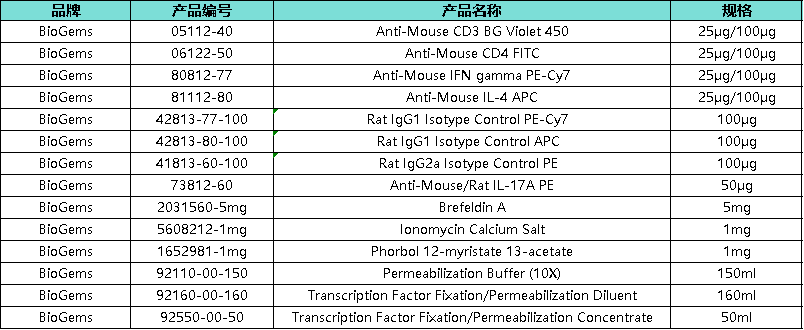
所需抗体以及辅助试剂:
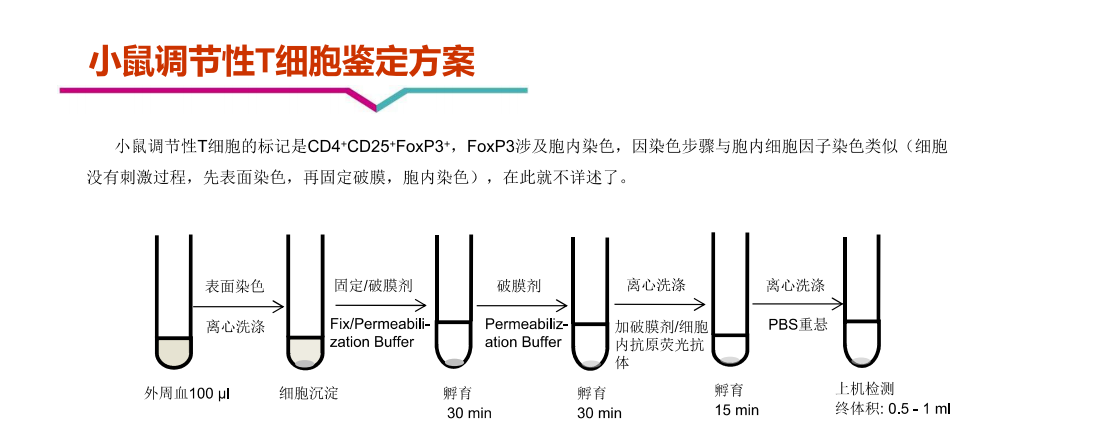
方案二 小鼠外周血调节性T细胞鉴定方案
Tips:
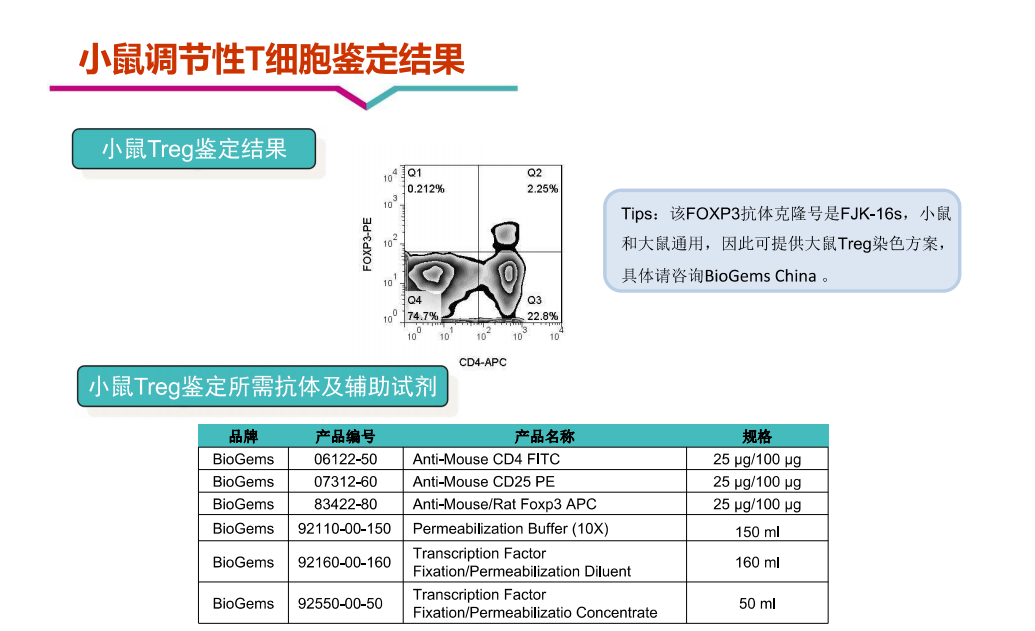
FoxP3检测的关键在于FoxP3克隆号和破膜剂,FoxP3克隆号有3G3、MF23以及FJK-16s,其中FJK-16s克隆号分群最明显,建议选择该克隆号的FoxP3,破膜剂使用不当会造成很高的背景以及细胞分群不明显,我们可以提供FJK-16s克隆号的FoxP3抗体以及优质的破膜剂(细胞形态改变小,分群清晰,背景低)。
产品引用文献
[1] Zhou T, Wu Y, Li S, et al. Multi-omic analysis of gallbladder cancer identifies distinct tumor microenvironments associated with disease progression. Nat Genet. 2025;57(8):1935-1949.
[2] Liu C, Ma R, Li H, et al. Akkermansia muciniphila ameliorates fatty liver through microbiota-derived α-ketoisovaleric acid metabolism and hepatic PI3K/Akt signaling. iScience. 2025;28(5):112458.
[3] Zhang Z, Yang Y, Chen Y, Su J, Du W. Malic enzyme 2 maintains metabolic state and anti-tumor immunity of CD8+ T cells. Mol Cell. 2024;84(17):3354-3370.
[4] Acúrcio RC, Kleiner R, Vaskovich-Koubi D, et al. Intranasal Multiepitope PD-L1-siRNA-Based Nanovaccine: The Next-Gen COVID-19 Immunotherapy. Adv Sci (Weinh). 2024;11(40):e2404159.
[5] Zhang XY, Shi JB, Jin SF, et al. Metabolic landscape of head and neck squamous cell carcinoma informs a novel kynurenine/Siglec-15 axis in immune escape. Cancer Commun (Lond). 2024;44(6):670-694.
[6] Luo Y, Liu F, Deng L, et al. Innate and Adaptive Immune Responses Induced by Aspergillus fumigatus Conidia and Hyphae. Curr Microbiol. 2022;80(1):28.
[7] Watson A, Li H, Ma B, et al. Human antibodies targeting a Mycobacterium transporter protein mediate protection against tuberculosis. Nat Commun. 2021;12(1):602.
[8] Zhang S, Ji WW, Wei W, Zhan LX, Huang X. Long noncoding RNA Meg3 sponges miR-708 to inhibit intestinal tumorigenesis via SOCS3-repressed cancer stem cells growth. Cell Death Dis. 2021;13(1):25.
[9] Zhang Z, Wang H, Xie X, et al. Long-Residence Pneumonia Vaccine Developed Using PEG-Grafted Hybrid Nanovesicles from Cell Membrane Fusion of Mycoplasma and IFN-γ-Primed Macrophages. Small. 2021;17(34):e2101183.
[10] Li Z, Zheng B, Qiu X, et al. The identification and functional analysis of CD8+PD-1+CD161+ T cells in hepatocellular carcinoma. NPJ Precis Oncol. 2020;4:28.
[11] Zheng B, Wang D, Qiu X, et al. Trajectory and Functional Analysis of PD-1high CD4+CD8+ T Cells in Hepatocellular Carcinoma by Single-Cell Cytometry and Transcriptome Sequencing. Adv Sci (Weinh). 2020;7(13):2000224.
[12] Zhou WJ, Zhang J, Yang HL, et al. Estrogen inhibits autophagy and promotes growth of endometrial cancer by promoting glutamine metabolism. Cell Commun Signal. 2019;17(1):99.
[13] Liu Q, Liu A, Leng S, et al. Itaconate derivative 4-OI inhibits M1 macrophage polarization and restores its impaired function in immune thrombocytopenia through metabolic reprogramming. Chin Med J (Engl). 2025;138(16):2006-2015.
[14] Ma J, Tang L, Tan Y, et al. Lithium carbonate revitalizes tumor-reactive CD8+ T cells by shunting lactic acid into mitochondria. Nat Immunol. 2024;25(3):552-561.
[15] Liu Z, Duan X, Yun Y, et al. Photoactivatable Aptamer-CRISPR Nanodevice Enables Precise Profiling of Interferon-Gamma Release in Humanized Mice. ACS Nano. 2024;18(4):3826-3838.
[16] Liu A, Liu Q, Leng S, et al. Identification of novel NFKB1 and ICOS frameshift variants in patients with CVID. Clin Exp Immunol. 2023;211(1):68-77.
[17] Karagiannis F, Peukert K, Surace L, et al. Impaired ketogenesis ties metabolism to T cell dysfunction in COVID-19. Nature. 2022;609(7928):801-807.
[18] Li W, Chen JY, Sun C, et al. Nanchangmycin regulates FYN, PTK2, and MAPK1/3 to control the fibrotic activity of human hepatic stellate cells. Elife. 2022;11:e74513.
[19] Chen Y, Huang H, Liu Y, et al. Engineering a High-Affinity PD-1 Peptide for Optimized Immune Cell-Mediated Tumor Therapy. Cancer Res Treat. 2022;54(2):362-374.
[20] Reustle A, Menig LS, Leuthold P, et al. Nicotinamide-N-methyltransferase is a promising metabolic drug target for primary and metastatic clear cell renal cell carcinoma. Clin Transl Med. 2022;12(6):e883.
[21] Zeng Y, Zhang Y, Huang X, et al. Novel acute hypersensitivity pneumonitis model induced by airway mycosis and high dose lipopolysaccharide. Respir Res. 2021;22(1):263. Published 2021 Oct 10.
[22] Tian J, Kou X, Wang R, et al. Autophagy controls mesenchymal stem cell therapy in psychological stress colitis mice. Autophagy. 2021;17(9):2586-2603.
[23] Cheng K, Du T, Li Y, et al. Dual-Antigen-Loaded Hepatitis B Virus Core Antigen Virus-like Particles Stimulate Efficient Immunotherapy Against Melanoma. ACS Appl Mater Interfaces. 2020;12(48):53682-53690.
[24] Zhang J, Chen C, Fu H, et al. MicroRNA-125a-Loaded Polymeric Nanoparticles Alleviate Systemic Lupus Erythematosus by Restoring Effector/Regulatory T Cells Balance. ACS Nano. 2020;14(4):4414-4429.
[25] Zhang J, Sun Z, Wu Q, Shen J. Prohibitin 1 interacts with signal transducer and activator of transcription 3 in T-helper 17 cells. Immunol Lett. 2020;219:8-14.
[26] Liu Z, Gu J, Qin Z, et al. Decreased Foxp3 and function of Tregs caused immune imbalance and liver injury in patients with autoimmune liver diseases post-liver transplantation. Ann Transl Med. 2020;8(8):534.
[27] Li Y, Jia A, Wang Y, et al. Immune effects of glycolysis or oxidative phosphorylation metabolic pathway in protecting against bacterial infection. J Cell Physiol. 2019;234(11):20298-20309.
[28] Chen W, Shi M, Shi F, et al. HBcAg-pulsed dendritic cell vaccine induces Th1 polarization and production of hepatitis B virus-specific cytotoxic T lymphocytes. Hepatol Res. 2009;39(4):355-365.